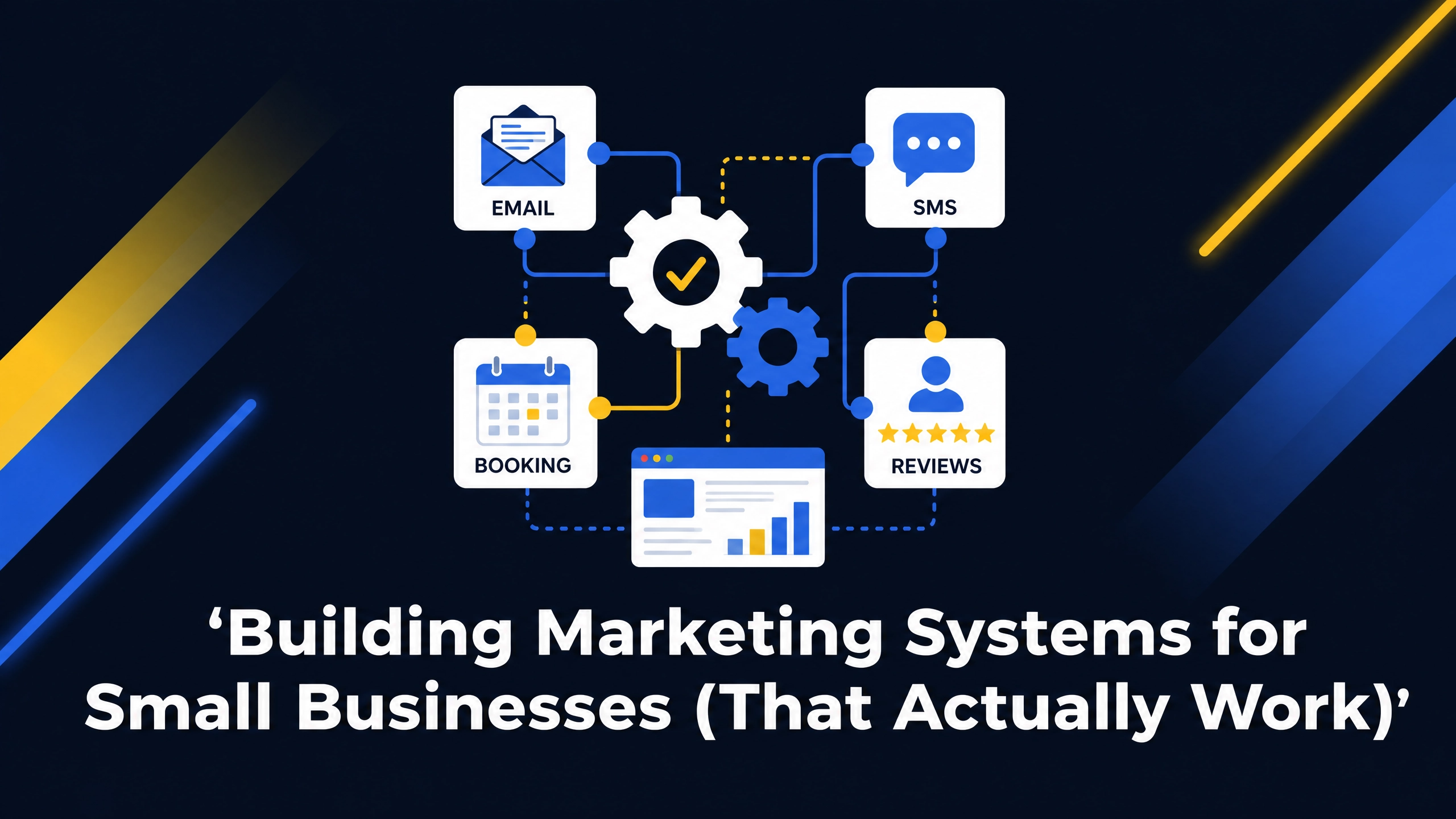
Building Marketing Systems for Small Businesses (That Actually Work)
For most owner-led businesses, "marketing" is a reactive, chaotic process. It usually involves boosting a Facebook post when things look quiet, sending an email newsletter once every six months, and hoping that word-of-mouth referrals keep the diary full.
This approach is exhausting. It relies entirely on the business owner remembering to do the marketing, which means it only happens when there is a lull in the actual work. When you are busy, marketing stops. When marketing stops, the pipeline dries up, leading to the inevitable feast-and-famine cycle.
The alternative is to build marketing systems. A system is a repeatable, structured process that operates regardless of how busy you are. It moves marketing from a frantic, manual task to a predictable, automated engine.
The Difference Between Tactics and Systems
A tactic is a single action: running an advert, posting on LinkedIn, or attending a networking event. Tactics are necessary, but on their own, they are inefficient.
A system is the infrastructure that supports the tactics. If you run an advert (a tactic) but have no automated way to capture the leads, follow up with them, and track their progress (the system), you are wasting money.
| Marketing Approach | Characteristics | Result |
|---|---|---|
| Tactical (Reactive) | Sporadic, manual, dependent on the owner's memory | Feast and famine revenue, high stress |
| Systematic (Proactive) | Automated, consistent, measurable | Predictable growth, scalable operations |
Small businesses do not need more complex marketing tactics. They do not need to be on every new social media platform or run convoluted advertising campaigns. They need simple, robust systems that ensure the basics are executed flawlessly, every single time.
The Three Core Marketing Systems Every Business Needs
You do not need a fifty-page marketing plan. You need three core systems operating in the background.
1. The Lead Capture System
When someone visits your website or interacts with your business online, you need a systematic way to capture their details. This means moving beyond a basic "Contact Us" form. It involves automated web chat, gated resources (like a pricing guide or checklist), and direct calendar booking links. The system must ensure that no matter how a prospect prefers to engage, the friction is minimal and their data is captured securely.
2. The Automated Nurture System
Not every prospect is ready to buy today. If you only focus on the people who are ready to sign a contract immediately, you are leaving the majority of your potential revenue on the table. A nurture system uses automated email and SMS sequences to stay in touch with prospects over weeks or months. It delivers value, builds trust, and ensures that when they are finally ready to make a decision, you are the only business they consider.
3. The Reputation Management System
Word-of-mouth is the lifeblood of a small business, but it should not be left to chance. A reputation system automates the process of asking for reviews. When a job is marked as complete or a product is delivered, the system automatically sends a polite request for a Google review. This builds your online authority systematically, rather than relying on you remembering to ask awkwardly at the end of a job.
Why Software Alone is Not the Answer
The common mistake business owners make is assuming that buying a piece of software is the same as building a system. They sign up for Mailchimp or a generic CRM, log in, and expect the marketing to happen automatically.
Software is just the tool. A hammer does not build a house, and a CRM does not build a marketing system. The software requires strategy, configuration, and well-written copy to function effectively.
This is why complex, enterprise-grade platforms often fail in small businesses. The owner simply does not have the forty hours required to learn the software, build the pipelines, write the emails, and test the automations.
The FoundationsAI Approach to Systems
FoundationsAI is designed to solve this exact problem. We do not just provide the software; we build and implement the marketing systems for you.
While platforms like GoHighLevel offer the technical capability to build these systems, going direct means you are entirely responsible for the strategy and execution. It is a blank canvas that requires significant technical expertise to configure correctly.
FoundationsAI provides the finished product. We implement the lead capture widgets, we write and configure the automated nurture sequences, and we set up the reputation management workflows. We build the infrastructure so that your marketing operates systematically, quietly, and consistently in the background, allowing you to focus on delivering the work.