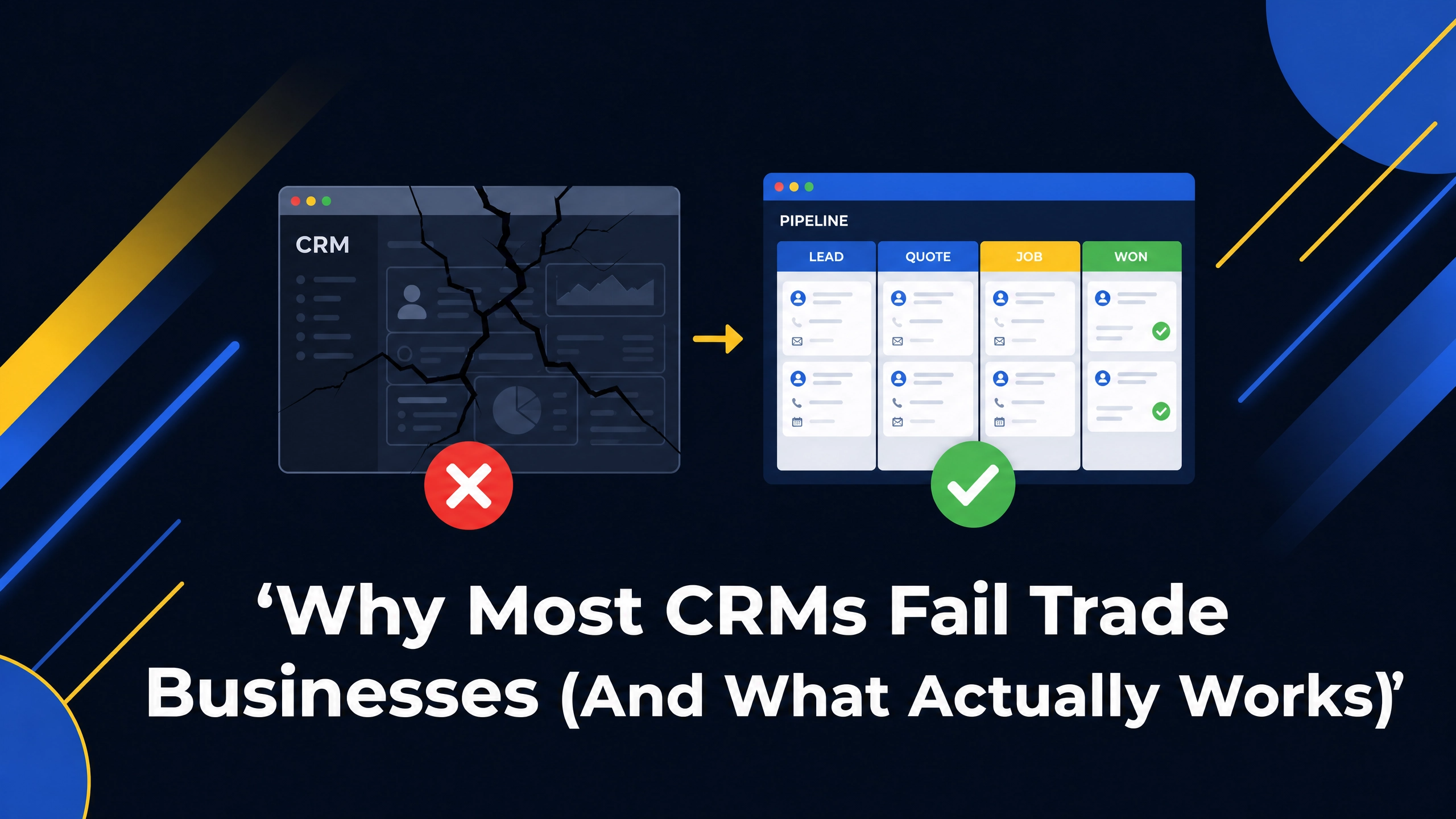
Why Most CRMs Fail Trade Businesses (And What Actually Works)
The trades sector operates differently from almost any other industry. You are not sitting at a desk managing a neat pipeline of digital leads. You are in a van, on a site, managing suppliers, dealing with weather delays, and trying to quote jobs in the evenings.
When trade business owners realise they need a system to manage this chaos, they usually look for a Customer Relationship Management (CRM) platform. The problem is that 90% of the CRMs on the market are built for desk-bound sales teams, not for electricians, plumbers, or builders.
Implementing the wrong CRM in a trade business does not solve the administrative burden; it adds to it. It forces you to change how you work to fit the software, rather than the software supporting how you actually operate.
The Reality of Trade Business Administration
A typical day for a trade business owner involves a barrage of fragmented communication. A new enquiry comes in via a website form. A supplier texts about a delayed delivery. An existing client calls to ask for a change to their quote. A subcontractor emails an invoice.
Trying to manage this across WhatsApp, a battered notebook, an email inbox, and a separate quoting tool is what creates the ceiling on growth. It is why jobs get delayed, quotes get forgotten, and follow-ups never happen.
| Administrative Task | Manual Method | Impact on Business |
|---|---|---|
| Capturing new enquiries | Writing on scraps of paper | High risk of lost leads |
| Following up on quotes | Remembering to call | Lost revenue, low conversion |
| Scheduling jobs | Whiteboard or basic diary | Inefficient routing, missed slots |
| Requesting reviews | Asking in person | Low response rate, poor online visibility |
A CRM is supposed to centralise this, but most fail because they require too much manual data entry. If a system requires you to sit down at a laptop for an hour at the end of the day to update records, you simply will not use it.
What a Trade CRM Actually Needs to Do
For a CRM to be effective in the trades, it must operate seamlessly in the background and be accessible from a mobile device. It needs to handle the heavy lifting of communication without requiring constant manual input.
First, it must consolidate communication. A trade business needs a unified inbox where emails, text messages, Google Business Profile messages, and website chats all appear in one thread per client. When you look at a client's record, you need to see every interaction, regardless of which channel they used.
Second, it must automate the routine touchpoints. When you send a quote, the CRM should automatically follow up via text and email three days later if it has not been accepted. When a job is marked as complete, the system should automatically send a polite request for a Google review. These are the tasks that slip when you are busy, but they are the tasks that drive revenue and reputation.
Third, it needs robust pipeline management that reflects the reality of trade jobs. A standard "lead > qualified > closed" pipeline is useless. You need stages like "Site Visit Required," "Awaiting Materials," "Quote Sent," and "Job Scheduled."
The Problem with Generic Solutions
Many trade business owners try to use generic, entry-level CRMs like HubSpot or basic Monday.com setups. These platforms are excellent for digital marketing agencies, but they lack the operational grit required for the trades.
They often struggle with SMS integration, which is critical for trade businesses where clients expect text updates about arrival times or quote approvals. They also tend to be overly complex, requiring a degree in software administration to set up basic workflows.
Conversely, trade-specific apps like Tradify or Fergus are excellent for job management and quoting, but they often fall short on the front-end marketing and lead nurturing side. They handle the job once it is won, but they do not help you win it in the first place by automating follow-ups and capturing leads effectively.
The FoundationsAI Solution for Trades
Trade businesses need a hybrid approach: the robust lead capture and automated follow-up of a marketing CRM, combined with the practical, mobile-first communication tools required for on-site work.
FoundationsAI provides this structure. We implement systems that capture enquiries from your website or Google Business Profile and immediately drop them into a structured pipeline. The system acknowledges the lead automatically via SMS, alerting you on your phone so you can respond when it is safe to do so.
While platforms like GoHighLevel provide the underlying architecture that can achieve this, buying the software direct leaves you with a blank canvas. You have to build the pipelines, write the follow-up sequences, and configure the SMS routing yourself.
FoundationsAI removes that burden. We build the specific pipelines your trade business needs, configure the automated review requests, and set up the unified inbox so you can manage all client communication from one app on your phone. We build the system to fit your operational reality, rather than forcing you to adapt to generic software.